
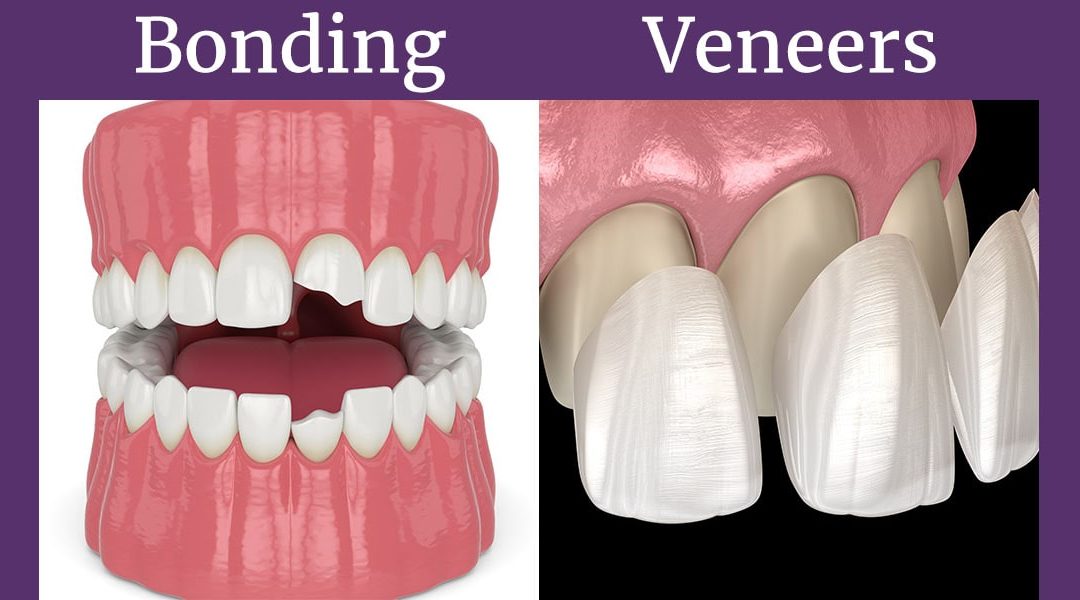
A chipped front tooth, a small gap between your two front teeth, or one tooth that just sits a little differently than the rest: these are exactly the kind of cosmetic concerns that make patients start Googling “bonding vs. veneers” at 11 p.m. Both treatments fix the same list of problems: chips, gaps, discoloration, and uneven or misshapen teeth. The real differences show up in cost, how long the results last, and how much of your natural tooth has to be altered to get there.
The short version: dental bonding is a fast, affordable, minimally invasive fix best suited for small, single-tooth repairs, while veneers are a longer-lasting, more durable option best suited for larger imperfections or a more complete smile transformation. Here’s how to figure out which one actually fits your situation.
What Is Dental Bonding?
Dental bonding uses a tooth-colored composite resin that your dentist applies directly to the tooth, sculpts by hand into the right shape, and hardens with a curing light. Because there’s no lab work involved, it’s typically completed in a single office visit.
Good candidates for bonding:
- A small chip on the edge of a tooth
- A minor gap between two teeth
- Slight unevenness in tooth shape or length
- Minor discoloration on one or two teeth
- Patients who want a reversible, lower-commitment option
Bonding’s advantages:
- Fast, often done in one visit, sometimes in under an hour per tooth
- Minimally invasive, little to no removal of natural enamel
- More affordable, typically $100–$400 per tooth
- Reversible, since minimal enamel is removed, it doesn’t permanently alter the tooth
Bonding’s trade-offs:
- Less durable, composite resin isn’t as strong or scratch-resistant as porcelain, and typically lasts 3 to 10 years before needing touch-ups or replacement
- More prone to staining, coffee, tea, red wine, and smoking can dull the resin’s shine faster than they would porcelain
- Limited scope, best for small, targeted fixes rather than a full smile makeover
What Are Veneers?
Veneers are custom-made, ultra-thin shells, usually porcelain or composite resin, bonded to the front surface of a tooth to change its shape, size, or color. Unlike bonding, which is sculpted in the chair, veneers are typically fabricated in a dental lab from an impression or digital scan of your teeth, which means the process usually takes two or more visits.
Good candidates for veneers:
- Multiple visible imperfections (chips, gaps, discoloration, uneven shape) you’d like addressed together
- A more dramatic, uniform “smile makeover” look
- Teeth with more significant chipping or wear
- Patients prioritizing long-term durability over lower upfront cost
Veneers’ advantages:
- More durable, porcelain veneers commonly last 10 to 15 years, and sometimes 20+, with proper care
- Highly stain-resistant, porcelain doesn’t discolor the way composite resin does
- More natural-looking light reflection, porcelain mimics the translucency of real enamel closely
- Comprehensive, can correct several issues across multiple teeth for a more uniform, even smile
Veneers’ trade-offs:
- More expensive, typically $500–$2,500+ per tooth, depending on material and case complexity
- Usually irreversible, traditional veneers require removing a thin layer of enamel to make room for the shell, which is a permanent change
- Takes longer, generally requires a prep visit, a temporary phase, and a final placement visit
Side-by-Side Comparison
| Dental Bonding | Veneers | |
| Best for | Small chips, minor gaps, single-tooth fixes | Multiple/larger imperfections, full smile makeovers |
| Procedure time | Usually one visit | Typically 2+ visits (prep + placement) |
| Cost per tooth | ~$100–$400 | ~$500–$2,500+ |
| Lifespan | 3–10 years | 10–15+ years (up to 20 with care) |
| Enamel removal | Little to none | Thin layer typically removed (mostly permanent) |
| Stain resistance | Lower, can dull or discolor over time | High, porcelain resists staining well |
| Reversibility | Generally reversible | Generally not reversible |
Which One Is Better for Your Specific Issue?
For a single chipped tooth: Bonding is usually the practical first choice since it’s fast, affordable, and appropriately scaled to a minor, localized repair. If the chip is large or on a tooth that takes a lot of biting force, your dentist may recommend a crown instead of either option, so this is worth a quick evaluation either way.
For a small gap between two teeth: Both bonding and veneers can cosmetically close a minor gap by adding material to the sides of the adjacent teeth. Bonding tends to be the go-to for a single small gap; veneers make more sense if you’re closing a gap and addressing shape or color at the same time. Neither option physically moves teeth, so if the gap is caused by alignment, orthodontic treatment may be the more appropriate long-term fix.
For uneven or misshapen teeth: If it’s one tooth that’s slightly off, bonding can often reshape it in a single visit. If several teeth are uneven relative to each other and you want a cohesive, matched look across your smile line, veneers tend to deliver a more consistent, uniform result since they’re custom-designed as a set.
For a full cosmetic overhaul: When you’re dealing with a combination of issues (chips, gaps, uneven edges, and discoloration all at once), veneers are generally the stronger long-term investment, since they can be planned and fabricated together for one consistent, natural-looking result rather than a series of individually touched-up fixes.
What About Cost Over Time?
Bonding wins on upfront price, but it’s worth thinking in terms of cost over the years you’ll actually keep the result, not just the initial bill. Because bonding typically needs replacing or touching up every few years, the cumulative cost over a decade can start to close the gap with veneers, which are a bigger investment up front but are built to go the distance without repeat visits. Neither answer is universally “better”; it comes down to whether you’d rather pay less now with some ongoing maintenance, or more up front for a longer stretch without thinking about it again.
A Note on Insurance
Most insurance plans treat both bonding and veneers as cosmetic procedures, meaning they’re typically not covered, unless the treatment is medically necessary, such as bonding used to repair a tooth chipped in an accident or to protect a tooth’s function rather than purely improve its appearance. It’s worth asking your dentist to note the clinical reason for treatment, since that can sometimes affect what your specific plan will cover.
The Bottom Line
There’s no single “better” option. There’s only the option that’s better for your specific tooth, budget, and goals. Bonding is the practical, lower-cost, same-day fix for small, isolated chips and gaps. Veneers are the higher-investment, longer-lasting choice for more visible or extensive cosmetic goals. The most reliable way to know which one is right for you is a short in-person evaluation, since photos and self-diagnosis online rarely capture the full picture: things like bite force, the size of a chip, or how a gap will actually look once closed.
If you’re considering either option in the Newark, DE area, we’re happy to take a look and give you a straightforward recommendation with no upselling, just what actually makes sense for your smile. Schedule a cosmetic dentistry consultation or learn more about our cosmetic dentistry services.
Frequently Asked Questions
Is dental bonding or veneers better for a chipped tooth?
For a small, isolated chip, dental bonding is usually the more practical option since it’s completed in one visit, costs less, and preserves more of the natural tooth. For a larger chip, or when several teeth need correcting together, veneers often provide a more durable, uniform result.
How long does dental bonding last compared to veneers?
Dental bonding typically lasts 3 to 10 years before it needs touch-ups or replacement, while porcelain veneers commonly last 10 to 15 years, and sometimes 20+, with good care and regular checkups.
Can bonding or veneers close a gap between my front teeth?
Yes, both can cosmetically close a small gap by adding material to the sides of the adjacent teeth. Neither option physically moves teeth, so larger gaps caused by alignment issues may still require orthodontic treatment for the best long-term result.
How much do veneers cost compared to dental bonding?
Dental bonding generally costs $100 to $400 per tooth, while veneers typically range from $500 to $2,500 or more per tooth depending on the material used and the complexity of the case.
Does dental insurance cover bonding or veneers?
Most insurance plans classify both as cosmetic procedures and don’t cover them, unless the treatment is medically necessary, for example, bonding to repair a tooth chipped in an injury. It’s worth asking your dental office to check your specific plan.
Is dental bonding permanent?
No, dental bonding is considered a reversible procedure since it requires little to no removal of natural enamel. It will need periodic touch-ups or replacement over time as the composite resin wears or stains.
Do veneers ruin your real teeth underneath?
Traditional veneers require removing a thin layer of enamel to properly fit the shell, which is a permanent change to the tooth. However, when placed and maintained properly, veneers don’t damage the underlying tooth and can protect it from further wear.
Which option looks more natural, bonding or veneers?
Both can look very natural when done well, but porcelain veneers tend to mimic the light-reflecting translucency of real enamel more closely and hold that appearance longer, while bonding can look slightly less lifelike over time as the composite resin dulls or stains.
Can I switch from bonding to veneers later?
Yes, many patients start with bonding for a quick, affordable fix and later upgrade to veneers if they want a more permanent or comprehensive result. This is worth discussing with your dentist in advance, since it can affect how much natural enamel is available for veneer placement.